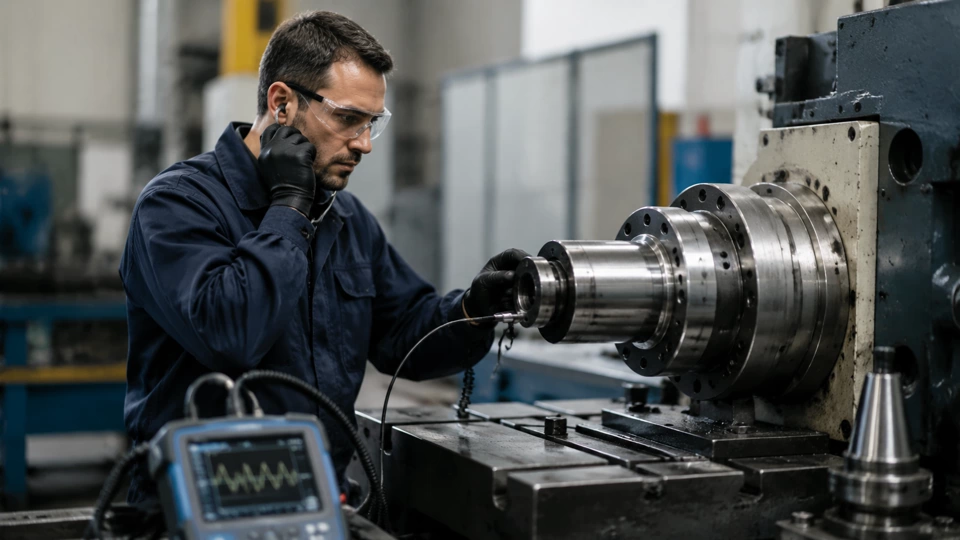
- Log vibration and temperature trends weekly to catch early bearing wear.
- Compare runout readings against OEM specs before choosing a path.
- Use a that checklist to document every decision point.
You're standing at a decision fork. The spindle is making noise, or the runout is creeping up, or the thermal growth is inconsistent. Do you repair the existing unit, send it out for a rebuild, order a new cartridge, or just monitor it for now? I've been in this spot more times than I can count, and the answer is never the same twice. The choice depends on symptom severity, budget, downtime tolerance, and how confident you are in your data. Let's walk through the branches.
Branch 1: Symptom – Vibration or Noise
Check vibration severity and bearing condition
If you feel vibration through the housing or hear a rumble that changes with speed, you're likely dealing with bearing degradation. I always start by logging baseline vibration levels at idle and operating RPM. Use an accelerometer if you have one; if not, your hand can tell you a lot. Compare your readings to the OEM's alarm thresholds. For example, on a typical 40-taper spindle, vibration above 0.15 in/sec at 10,000 RPM is a red flag. If vibration is below that and the noise is intermittent, monitoring might be safe for a few weeks. But if it's constant and rising, you need to act.
Next, check the bearing preload and lubrication. In Ohio shops, we see a lot of contamination from coolant mist that washes out grease. If the bearings are dry or the preload has loosened, a simple regrease and preload adjustment might buy you time. But if the races are brinelled or spalled, repair is just a band-aid. I've seen operators try to run a noisy spindle for months, only to have it seize and damage the housing. That turns a $2,000 bearing job into a $10,000 spindle replacement. So be honest about the severity.
If you decide to open the spindle, document everything on a spindle service record checklist. Note the bearing part numbers, the condition of the races, and any scoring on the shaft. That checklist becomes your baseline for future comparisons. Without it, you're guessing. I've learned that the hard way.
Branch 2: Budget – Rebuild vs. Replace
Compare rebuild scope and replacement cost
Once you know the bearings are shot, the next fork is budget. A full rebuild – new bearings, regrind the taper, replace seals, and balance – typically runs 40-60% of a new cartridge. For a standard 50-taper spindle, that might be $3,000-$5,000 versus $8,000-$12,000 for a replacement. But rebuild scope matters. If the shaft is scored or the housing bore is worn, a rebuild might not restore original accuracy. I always check the taper runout with a tenths indicator. If it's over 0.0005" TIR, a regrind is needed, and that adds cost.
On the other hand, replacement gives you a fresh start with new technology. Some newer spindles have better thermal compensation or higher speed ratings. If your machine is less than five years old, replacement often makes sense because the rest of the machine can still deliver the accuracy. But for older machines, a rebuild is usually the smarter move. I've replaced spindles on 20-year-old mills only to find the ways are worn, so the new spindle doesn't improve part quality. That's money wasted.
Don't forget the hidden costs: downtime. A rebuild might take two weeks if you send it out; a replacement can be swapped in a day if you have a spare. But if you don't have a spare, you're down either way. I keep a log of spindle service baseline log notes for every machine so I can predict failures and order parts ahead. That proactive approach saves us weeks of downtime per year.
Branch 3: Downtime Risk – Monitor vs. Act
Assess production schedule and spindle confidence
If the symptom is mild and you have a tight production deadline, monitoring might be the least disruptive path. But monitoring isn't passive; it requires a plan. I set up a weekly check: measure runout at the taper, log vibration, and check temperature after a 30-minute warm-up. If any parameter changes by more than 10% from baseline, I escalate. For example, if runout goes from 0.0002" to 0.0003", that's a warning. If it jumps to 0.0005", it's time to act.
Confidence level is key. If you've been logging spindle service baseline log notes for months, you have a trend. A sudden spike is different from a gradual drift. I once had a spindle that showed a slow increase in vibration over six months. We scheduled a rebuild during a holiday shutdown and avoided any unplanned downtime. That's the power of good records. But if you have no baseline, you're flying blind. In that case, I recommend a full inspection now, even if it means a short outage.
Another factor: the cost of a crash. If the spindle fails catastrophically, it can damage the tool holder, the workpiece, and even the machine's Z-axis. I've seen a bearing cage disintegrate and send metal fragments through the coolant system. That cleanup alone cost us a week. So if the risk is high and the spindle is critical, act sooner rather than later. Use the decision tree: if vibration > 0.2 in/sec or runout > 0.0005", skip monitoring and go straight to repair or replace.
Branch 4: Confidence Level – Data-Driven Decision
Use your log to choose the next move
Your spindle service baseline log notes are your best tool. If you have six months of weekly data, you can calculate the rate of degradation. For instance, if runout increases 0.0001" every month, you can predict when it will exceed tolerance. That gives you time to order parts and schedule the work. But if you only have one data point, you can't know if it's a one-time anomaly or a trend. In that case, I take three measurements over a week to establish a baseline.
I also track thermal growth. A spindle that takes longer to stabilize or runs hotter than usual indicates bearing friction or preload issues. ANSI standards suggest a maximum temperature rise of 40°C above ambient for grease-lubricated bearings. If you're hitting 50°C, you have a problem. I log the temperature after 30 minutes at max RPM. If it's climbing, I know the bearings are dragging. That's a strong signal to rebuild.
Finally, consider the machine's overall condition. If the spindle is the only weak point, invest in a quality rebuild or replacement. But if the machine has other issues – worn ways, bad ballscrews, or a failing control – it might be time to retire it. I've had to make that call a few times. It's never easy, but a new spindle on a worn-out machine is like putting new tires on a car with a blown engine. Use your judgment and your data.
Decision Table: Quick Reference
Decision checkpoint
| Decision signal | Branch | Next move |
|---|---|---|
| Vibration < 0.1 in/sec, runout < 0.0002" | Monitor | Log weekly, check again in 1 month |
| Vibration 0.1-0.15 in/sec, runout 0.0002-0.0004" | Inspect | Check preload, regrease, retest |
| Vibration > 0.15 in/sec, runout > 0.0004" | Rebuild | Send out for bearing replacement and regrind |
| Vibration > 0.2 in/sec, runout > 0.0005" or housing damage | Replace | Order new cartridge, swap immediately |
This table is a starting point. Every spindle is different, and your own experience matters. I've had spindles that ran fine at 0.0006" runout for years, and others that failed at 0.0003". The key is consistency. If you log the same parameters every time, you'll see the pattern. And when you do, you'll know exactly which branch to take.
Final Field Note: Building Your Baseline
Start logging today
If you don't have a spindle service baseline log yet, start one now. It doesn't have to be fancy – a notebook or a spreadsheet works. Record the date, spindle hours, runout at the taper, vibration at idle and operating speed, temperature after warm-up, and any unusual noises. Do it every week for the next month. After that, you'll have a baseline. Then when something changes, you'll see it immediately. I've been doing this for over a decade, and it's saved us countless headaches.
Remember, the goal is to avoid emergency repairs. A planned rebuild during a shutdown costs a fraction of a crash repair. And with good logs, you can schedule that rebuild at the right time. Use a that checklist to make sure you don't miss any steps. That checklist is your roadmap. Keep it in your toolbox or on your tablet. Every time you open a spindle, fill it out. Over time, you'll build a history that tells you exactly when to act.
One more thing: don't ignore the small stuff. A slight change in sound or a tiny increase in temperature is your spindle talking to you. Listen to it. Log it. Then decide. That's the difference between a maintenance pro and a parts changer.
This article is informational and based on my field experience as Derek Holloway, CNC Maintenance Advisor. Always consult your machine manual and OEM specifications before making repair decisions.